
If Greece were to update the list of its modern-day philhellenes, Andrea Marcolongo would undoubtedly top it—a writer who returns year after year, not just in body but in spirit, offering readers stories that rekindle awe for a civilization still burning beneath the surface of everyday life.
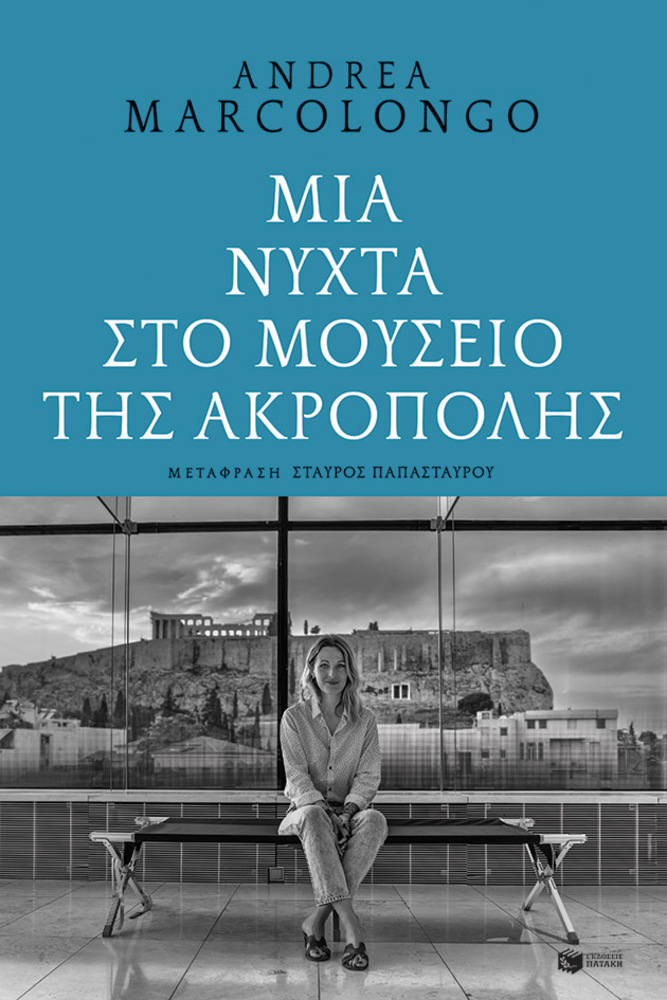
Andrea marcolongo is a renowned Italian classicist and bestselling author whose work bridges the ancient and the modern with rare sensitivity and insight. Having studied classical literature at the University of Milan, she has spent years exploring the enduring legacy of Greek thought. On the occasion of her latest book, Moving the Moon: A Night at the Acropolis Museum, she returns—both literally and spiritually—to the heart of Greece, to reflect on memory, absence, and the timeless presence of ancient beauty.
What was the most unexpected feeling you experienced while walking through the Acropolis Museum at night?
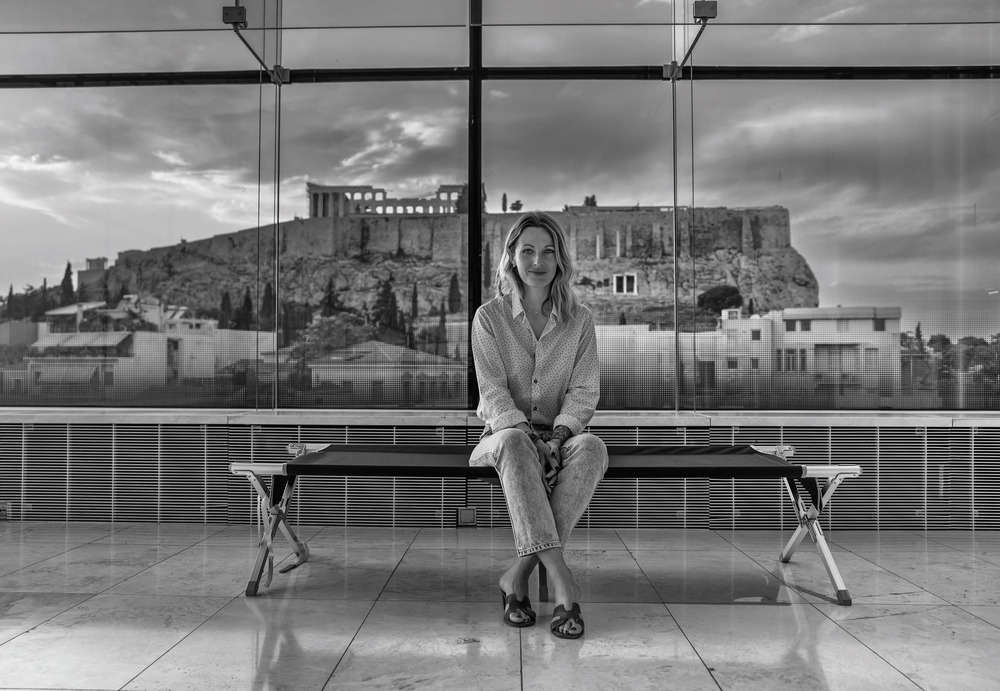
“I wonder how it will feel,” my friends said before I left, “to sleep under the gaze of all those marble eyes.” As I waited for sunset to draw back the curtain on the light of Athens, my eyes swiftly traced what remains of the Parthenon’s friezes and metopes. I managed to glimpse a few fragmented heads, many feet, several arms, the muzzle of a horse or two. But the faces of those eternal men and women—sculpted by Phidias’ school to gaze and to be gazed upon—are no longer here. Time has devoured them. Or they have been decapitated by human greed, which carried those heads away. And so I began to reflect on presence and absence, on the voids of history and the emptiness within the human soul. They say that with time and faith, the void within the soul can be healed. But the void within a museum—how is that repaired? Is it merely a logistical matter of restitution, the long-awaited gesture the Greeks have hoped for nearly a century, for which they built this modern museum where I spent the night? Or is absence, once it has been carved out, forever unfillable? Is it truly enough to simply rewind the reel of days and of lies, to put things back in their rightful place— be it a toothbrush on a bathroom shelf or Phidias’ marbles upon the Parthenon—for order to be restored, for the void to become once more full?
That unforgettable night, I felt alone before history—fully aware I was living something extraordinary—and alone before my own emptiness.
Was there a moment during the evening when you felt completely transported, as if time dissolved between past and present?
That unforgettable night, I felt alone before history—fully aware I was living something extraordinary—and alone before my own emptiness. It was an incredible opportunity to reflect on my relationship with ancient Greece, on how much I owe this land and its inexhaustible culture. I owe Greece everything—literally the whole life I lead: my thoughts, my friends, my books, the education I passed on to my daughter, the way I inhabit the world. And I am not alone in this. I am neither the first, nor the only one. Europe as a whole, since the time of Alexander the Great, has done the same. From Greece, we have always taken—dug, extracted—without guilt. And with Greek ideas, through the centuries, we have built our very notion of European culture and civilization. For decades I studied only ancient Greek history, but my travels to Athens compelled me to delve into modern Greek history, which is even more fascinating. Nowhere else in the world does one abandon reality so serenely, so effortlessly, for the realm of dream. In Greece, the marvelous always arises from the necessity of myth. To reconcile the spirit of ancient Greece with its modern history—that, I believe, is the truest key to understanding this infinite land, and its only true heirs: the Greeks.
How did being surrounded by the original artifacts in Athens influence your thoughts on the Parthenon Marbles still held abroad? Did it feel like something vital was missing, or something waiting to come home?
The aim of this book is twofold. First, to make known to a foreign audience the extraordinary story of the Parthenon Marbles—a story few know in detail. It is a tale so tragic it might have been written by Aeschylus, and one that still cries out for redress. Much is being said today about the restitution of artworks, especially in France, where I live, and I believe the Parthenon case could become a model—not only for Greece, but for all of Europe.
Second, I wanted to sound a warning to those who no longer recognize the value of culture, of ancient art and philosophy. If two centuries ago an English ambassador could carry off tons of marble without consequence, then it is our duty now to protect classical knowledge from neglect and oblivion. It is more fragile, more immaterial—and perhaps even more precious—for it could vanish forever. The history of art has always been, from the very beginning, a history of diplomacy. Even in the Iliad, the victors carry off a sacred object from their enemy—the Palladium. Art has never existed solely to be displayed in a museum; above all, it has existed to be stolen. Modern diplomacy now faces the very same problems that have marked the past centuries—because the history of art is nothing other than the history of humankind: colonialism, domination, violence, war. In this sense, the diplomacy of art may now become the clearest path toward repairing a past that can no longer be ignored or accepted.
What did you learn about yourself while writing this book?
As I packed my things the next morning, I gave a silent farewell to the shattered marbles of the Parthenon. I have not returned to the Acropolis Museum since. I promised I would do so when I present the Greek edition of my book in Athens, the one that matters most to me. What remains is a deep feeling of belonging to Greek history—its material, physical, tangible dimension. Thanks to that night beside the marbles, the classical world seemed, for the first time, like something concrete, no longer untouchable. The time when the Parthenon stood intact and proud atop Athens is long gone and forever lost. But the Acropolis remains the backdrop where our thoughts take shape. The great error of humankind—the source of so much strife and misfortune—is to search restlessly for what unites us in one another, instead of looking behind us, into the folds of history. Into Greece. And so I remember what Seferis asked, gazing upon the Acropolis: Where are the souls of all those who built these monuments—where are they now? Their souls have become ours.