
On September 25, a significant tribute to the late Lucas Samaras will open at The Intermission in Piraeus, Greece. Organized in collaboration with Pace Gallery, this exhibition marks the artist’s first solo presentation in his birthplace in nearly twenty years—and the first since his passing in March 2024. Featuring works that span his six-decade career, the exhibition offers a rare and intimate look at the evolution of a truly genre-defying artist.
Spanning six decades of boundary-defying practice, the exhibition will feature works from the 1960s through the 2010s, offering a rare opportunity to engage with the full range of Samaras’s protean oeuvre. From manipulated Polaroid self-portraits to immersive mirror rooms, and from psychedelic digital compositions to hand-crafted sculptural jewelry, the show reflects the artist’s lifelong interrogation of identity, transformation, and the self as subject.
Born in Kastoria, Greece in 1936 and immigrating to the United States at the age of 12, Samaras emerged as a central figure in the New York avant-garde of the mid-20th century. His early involvement in Happenings—the hybrid installation-performance works led by Allan Kaprow—formed the basis of a radical practice rooted in autobiography and personal myth. Over the years, Samaras developed a body of work that eluded art historical categories, traversing sculpture, painting, photography, digital media, and assemblage, all while keeping the body and psyche at the heart of his inquiry.
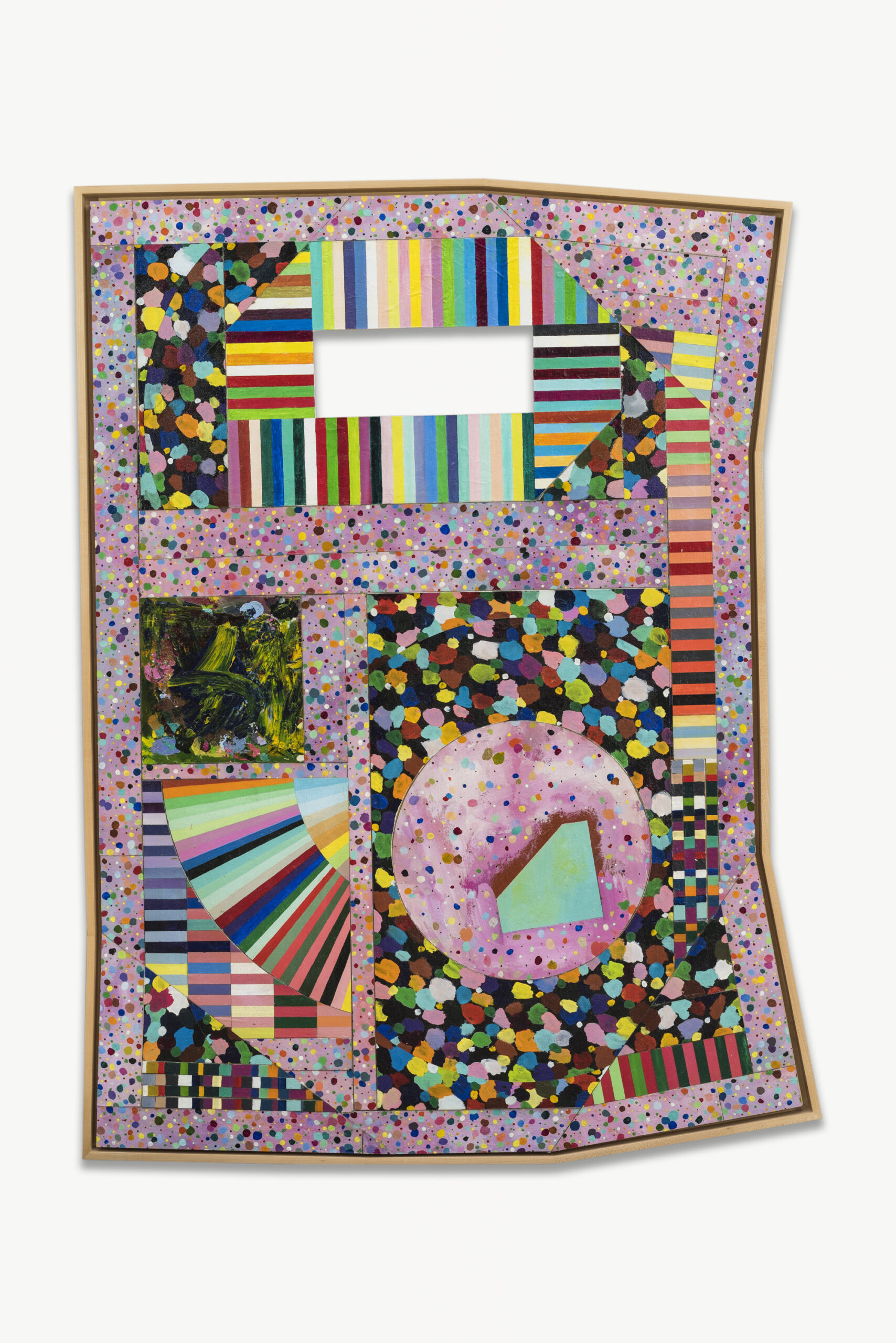
The exhibition at The Intermission will showcase rarely seen pieces across a wide range of media: the iconic Auto-Polaroids and Photo-Transformations from the late 1960s and early ’70s, richly textured pastels, chromatically dense Mosaic Paintings, fabric-based Reconstructions, and a suite of his intricate Box sculptures—miniature worlds built from everyday objects like mirrors, cutlery, feathers, and colored string.
Also on view will be a selection of sculptural jewelry, produced between 1996 and 1998. Samaras crafted these wearable works by manipulating chicken wire into expressive forms, later cast in 22-karat gold. The resulting pieces confront the viewer with a paradox of material: fragile yet opulent, intimate yet imposing. These works reflect the artist’s lifelong interest in the tension between adornment and constraint, as well as the enduring sensory power of objecthood.
The show also celebrates Samaras’s nearly 60-year relationship with Pace Gallery, which began in 1965 and endured throughout his life. Following his death, his work has received renewed attention: in September 2024, Dia Beacon inaugurated a long-term installation of his Cubes and Trapezoids series alongside the mirror room Doorway (1966/2007)—his final collaboration with a museum. Earlier in 2025, 125 Newbury, the project space of Pace founder Arne Glimcher, presented a focused exhibition of never-before-seen pastels from the 1960s shown in conversation with figurative bronze sculptures from the 1980s.
This Piraeus exhibition arrives at a time when Pace Gallery is marking its 65th anniversary with a global program dedicated to artists who helped define its legacy, including Agnes Martin, Robert Mangold, Louise Nevelson, and Lucas Samaras himself. With this show in Greece—his birthplace and a place that deeply shaped his sensibility—the gallery pays homage to an artist who never stopped evolving, questioning, and defying convention.
Samaras’s artistic path began with pastel self-portraits during his time at Rutgers University, where he studied under Allan Kaprow and George Segal, later continuing at Columbia University under the guidance of art historian Meyer Schapiro. By the early 1960s, he began creating assemblages with materials gathered from his everyday environment—objects from five-and-dime stores, transformed into poetic, intimate constructions. These works would later evolve into his famed mirror rooms and digital mirror-imagery, all reflecting his deep engagement with reflection, sensation, and the blurring of art and life.
His photographic experiments began in earnest in 1969 with the Polaroid 360, later progressing to the SX-70, which allowed him to physically manipulate images during the chemical development process. In 1996, he turned to digital art, eventually incorporating Photoshop into his practice and creating the PhotoFictions series—swirling, fractured self-portraits that mirror the psychological complexity of his early work, updated through digital means.
Learn More: www.theintermission.art