
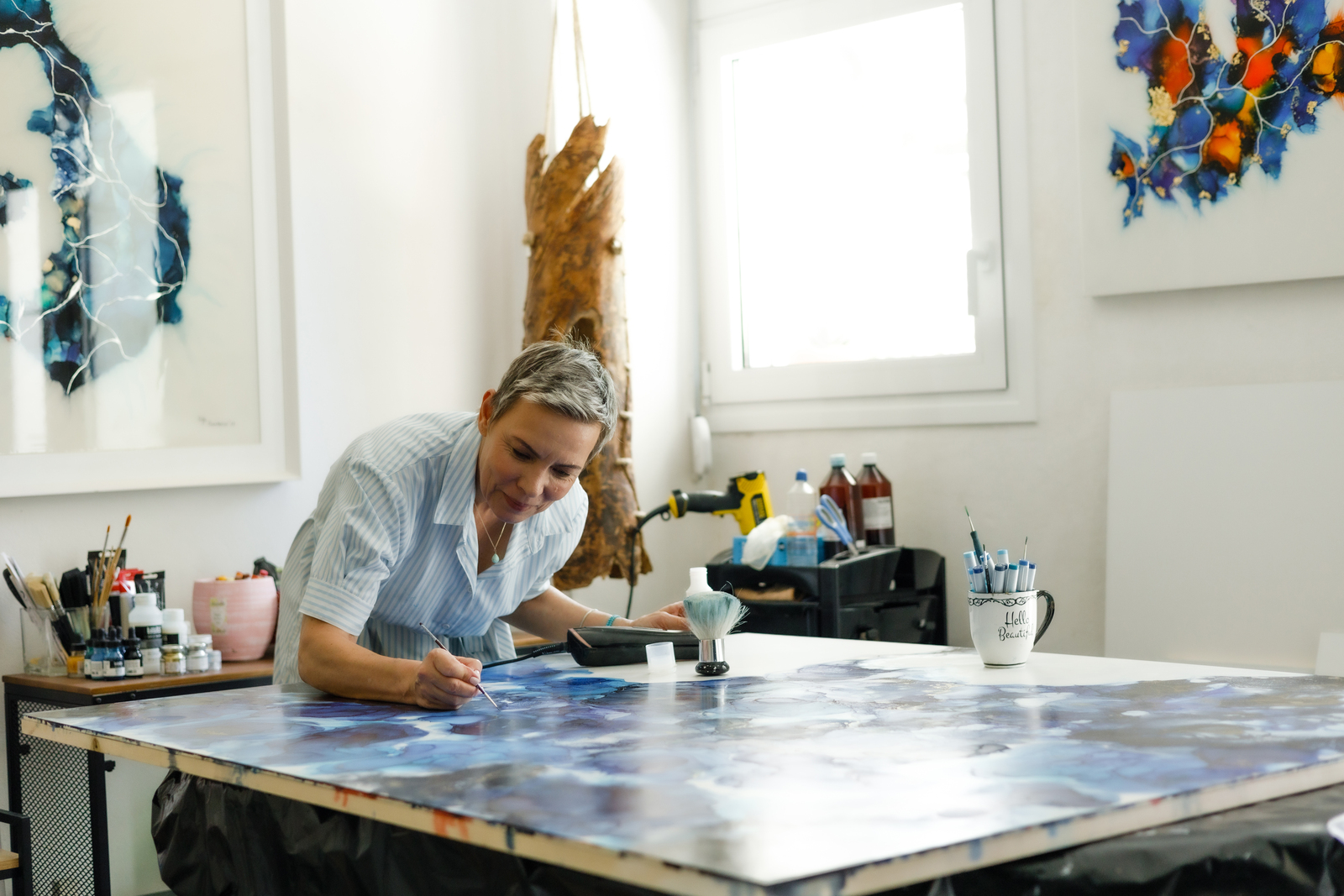
Svetlana Booth is a mixed-media artist and the originator of Abstractural Art, a visual language that fuses precise geography with abstraction. Born in Havana, raised in Russia, shaped by years in South Africa, and now based in Varkiza, she carries a life of crossings that naturally converges on the Athenian Riviera. Through alcohol inks, gold and silver leaf, and layered resin, she transforms islands, coastlines, countries, and cities into “Islands of Souls”, a series of paintings and her artistic philosophy, a way of understanding place as living memory and emotional presence expressed through art. Inspired by Mediterranean geographies, her work explores how certain places remain within us long after we leave them.
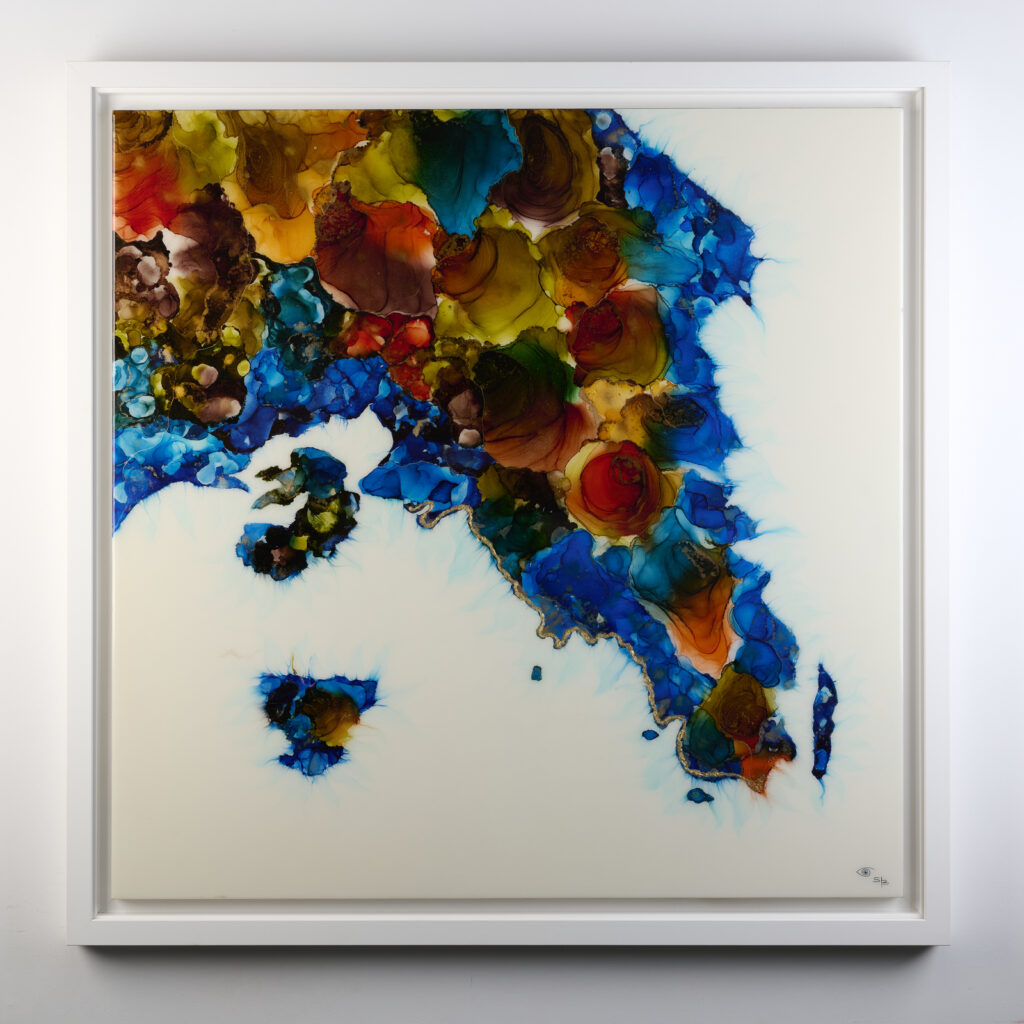
What inspired your painting Athens Riviera: The Geometry of Light and what does it represent for you? Can you describe the process behind creating this specific work?
I live in Varkiza, so the Athenian Riviera is not a distant landscape for me. The morning light over the water, the changing blues of the horizon, the quiet line where Athens opens towards the sea are a part of my daily rhythm. Over time, this coastline became a lived emotional geography.
I wanted to create a work that held not only the physical beauty of the Riviera, but also its emotional presence. The process began with the real geography of the coast. In my Abstractural Art, structure is essential. The coastline gives the work its foundation. From there, abstraction begins to breathe.
I worked from the curve of the Riviera, allowing the line from Piraeus to Sounion to become the structural and emotional spine of the piece. Then the colours had to find the spirit of the place. As the layers developed, the work began to move beyond map and coastline. The final layer of resin deepened everything, holding colour, light, and movement beneath a luminous surface. For me, the Athens Riviera is not a map in the traditional sense, but a portrait of a place that has become not only where I live, but where I belong.
What does the Athenian Riviera mean to you emotionally and creatively?
The Athenian Riviera is where I learned to listen to light. Walking each morning along the coast in Varkiza and in the hills above the extraordinary landscape of Lake Vouliagmeni, I have come to feel that light here is never static; it moves, breathes, and transforms the same place again and again. In winter, the sea becomes silver and introspective, and the whole coastline feels hushed, inward, almost meditative. Then summer arrives, and the light shifts from silver to gold, the blues grow warmer, the rocks seem to glow, and the air itself feels charged with freedom and intensity.
What moves me here is not only beauty. There is an ancient resonance along this coastline that I feel very strongly, especially in relation to the sacred isosceles triangle formed by the Parthenon, the Temple of Aphaia on Aegina, and the Temple of Poseidon at Sounion, a geometry that I explored in Athens Riviera: The Geometry of Light.
Your Abstractural work has a dreamlike quality. Do you remember your dreams, and if so, do they influence your visual world?
The dreamlike quality in my work does not come from dreams in the literal sense, but from transformation. From the moment when precise geography begins to move beyond the map and become something alive. This is also why I call my visual language Abstractural Art: it is a fusion of structure and the abstract. The structure comes from real geography, the exact form of an island, coastline, country, or city. The abstract comes through the inks giving colour, movement, emotion, and energy.
My work often begins with a geographically accurate form. But as the creative process unfolds, the image gradually enters another state. When the shimmering forms appear around the island, what I sometimes call my luminous tentacles, the work begins to float, to breathe, and to reveal its soul. This is where the dreamlike quality enters: not from sleep, but from awakening.
How did you first discover painting, and when did you realise it was the right form of expression for you?
Creative expression was present in my life long before I ever picked up alcohol inks. In my youth, I was an acrobatic gymnast, and later I was drawn to dance, both forms taught me about movement, rhythm, balance, tension, and release.
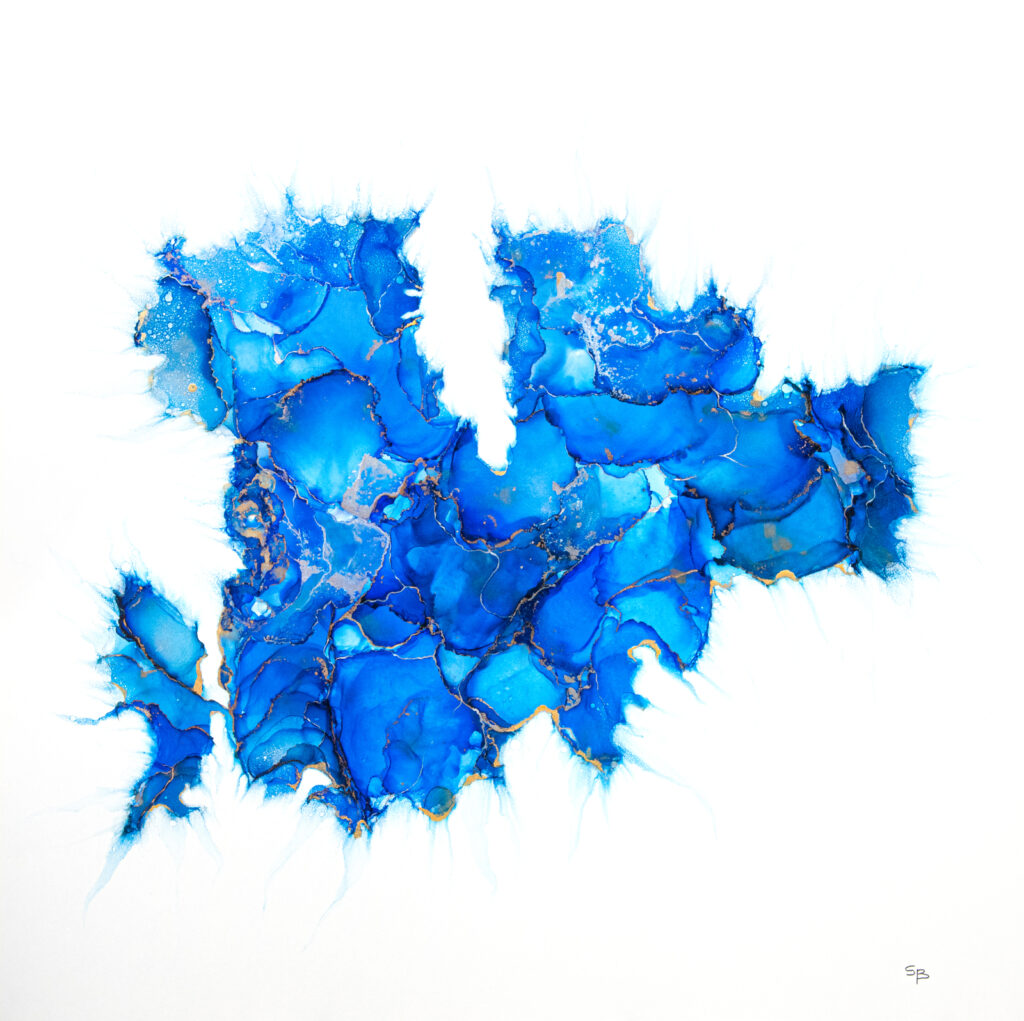
Alcohol inks arrived in my life at exactly the moment I was searching for a new creative language. I was captivated by their movement, the way colour could flow, merge, resist, and create forms that felt alive. At first, I was fascinated by the medium itself. But gradually I realised I was not simply exploring colour and technique. I was beginning to create a visual language of place, memory, and emotional connection.
The turning point came with the development of my philosophy, Islands of Souls. My own life has been shaped by different countries and cultures, so the idea of place has always been deeply personal to me. When I realised that painting could hold place, memory, identity, belonging, and human connection all at once, I knew it had become my true form of expression.
Are you already working with other forms of art beyond painting, or do you see yourself exploring them in the future?
Painting is my central language, but I have always felt that Islands of Souls could grow beyond the canvas. I am interested in the geographies people feel connected to, and in the places that continue to live within them. In that sense, Islands of Souls is not only a series; it is a way of revealing the soul of place.
One idea very close to my heart is Letters to Places, a future book and artistic archive where people can write to the places that live on within them: places of love, departure, return, transformation, and belonging. I also dream of creating spaces where art is not only seen but entered; immersive environments where viewers can feel as if they are walking inside a painting. The medium may evolve, but the longing remains the same: why do certain places stay with us long after we leave them?